|
|
|
Bill Lee: The
Spaceman of Baseball |
|
|
|
|
|
Lois Siegel
Filmmaker/Photographer
|
|
Bill Lee: A
Profile of a Pitcher |
|
Reporter: What kind of goals do you
set for yourself as a pitcher? Bill Lee: Perfection. Being able to materialize the ball into the catcher's mitt without throwing it. |
|
In Montreal, two American national pastimes were
exotic: one was film and the other was baseball. Therefore, what
could be better than a film about a baseball player.
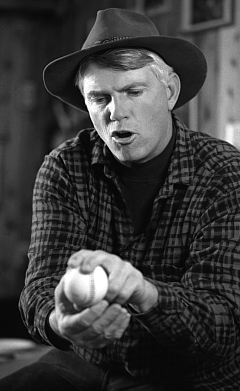
"Bill Lee: A Profile of a Pitcher" (winningest hurler for the Expos, 1979, is just that film. It was directed by Bill Reid for Double Bill Films. When Reid worked for The National Film Board of Canada, he made films with a personal style: "Back Alley Blue," "Occupation," and "Coming Home," which won a Canadian Film Award. It was like a home-movie. (Reid comes home and talks to his parents, complete with the generation gap). The "Bill Lee" film might also be called a home movie in the sense that Reid zeroes in on Bill Lee's life and philosophy, keeping the rough edges in. It's not a slick, smoothed-out, sterilized narrative. Somehow it fits in with Lee's way of doing things and therefore leaves the audience room to breathe. Lee is an effervescent wit - a man easy with words which just keep coming.
The filming style is disjointed, but this adds to the 'feel' of the picture. Lee's life, we learn, is usually in turmoil. His wife wants to divorce him, but Lee doesn't believe in divorce: "Love is temporary insanity," he quips. "No one gets out of here alive." Lee's wife (who we never see) has hired a lawyer. She has joined the 20th century ranks of manipulation. Lee doesn't believe in lawyers, so she wins. Lee says she can keep the material possessions. All he wants is his shotgun and a football. "We're not always in sync." (pause) "We're always a little out of sync," Lee states. Other turmoils are caused by his being a public figure in a world where the media and the masses eat stars alive - and in the film we see the consequences. A journalist from "The Village Voice" comes to Montreal to 'get a story' on Bill Lee. She's the type of journalist who makes other journalists feel embarrassed. She constantly throws Lee curve-ball questions, which are expressed with mechanical assertiveness. But Lee hangs in there and doesn't let her get to him. |
|
Journalist: You're not going to save the
world. Bill Lee: But I'm not going to cop out either. |
|
One isn't sure why Reid chose to leave so much
footage of this irritating 'bad guy' journalist in the film, but the
result is that the viewer senses Lee's vulnerability in a world
which is very screwed up. One suspects
that what makes Lee a credit to society is also what makes him a
good pitcher - but his life is full of incongruities, and it's
sometimes hard to put his philosophy and his baseball-playing
together. This "Space Man," as he is called, seems to be something
new to baseball. He's not a 'dumb' ballplayer - as intellectuals
habitually label athletes. He's smart, and he's sensitive. Reporters love to quote him and joke about him - he's food for thought. In the film one TV newscaster announces "Bill Lee just flew to Florida for spring training - probably without a plane." Lee wears the same number '37' as the famous temperamental Cleveland Indian Jimmy Piersall did - but Lee doesn't need to throw bats out of the dugout to get attention. He uses his arm and his head.
A baseball fan's strongest desire is to get as close to the game and the players as possible. The film shows this - Montreal spectators appear with intent faces, donning blankets over their shoulders to keep out the rain and the cold. Another fan cuddles a transistor radio to his ear. The camera, controlled by Martin Duckworth and Serge Giguere with additional shots by Guy Borremans, looms in almost uncomfortably close. We see everything in extreme close-up - which often cuts off our vision and forces us to lose a sense of the play-by-play action, but somehow that doesn't matter. This is a film about a man and just peripherally about the game of baseball. Baseball fans in the theater audience feast on glimpses of the 'behind the scenes' images. As a game opens, the umpires, with their backs towards us, quip about there being two National Anthems in Montreal. We constantly get that 'down home' feeling from the film: we see Lee driving his van to the ball park, getting caught in traffic with the rest of the fans. "Why don't you take the subway to the game!" Lee yells out his window. "I work here," he smiles. The film makes you want to get to know Bill Lee better. You like him, and his humor and openness makes you feel how vulnerable any intelligent individual is. One goes away from "Bill Lee: A Profile of a Pitcher" thinking about things other than baseball. One goes away thinking about the world and how someone like Bill Lee can force us to look at what's around us in a new way. In a world of media-controlled thinking, that seems pretty important. |
|
This article by Lois Siegel
appeared in "Cinema Canada," December 1981 -January, 1982. © Lois
Siegel. A decade later, Bill Lee appeared in her documentary
film "Baseball
Girls."
|
|
|
|
|
|
|