Triage: Dr. James Orbinski's Humanitarian Dilemma, 88 minutes, 2007,
Canada
Directed by Patrick Reed
National Film Board of Canada
White Pine Pictures
Dr. James Orbinski lays a moral dilemma in our laps: how does one
maintain clarity of mind and objective detachment when one must make a "Sophie’s
Choice" a hundred times a day, a choice of who will receive medical
treatment and who will be allowed to die?
What would be but a mere
intellectual exercise in a university philosophy ethics class becomes
the existential downside of the necessary triage procedure in a
makeshift medical treatment centre in Kigali, Rwanda in 1994. Dr. James
Orbinski, a member of
Médecins Sans Frontières (aka Doctors Without Borders), was called
upon to classify the patients at arrival: who would be given immediate
medical treatment, who would be asked to wait, and who would be judged
as dying and would receive only solace and comfort.
The Rwandan genocide of 800,000
Tutsi tribes people in a short space of a hundred days by a Hutu
minority, mostly by machete attacks, was ignored by the international
community. The United States declined to send aid, despite warnings by
their own intelligence sources of impending mass slaughter. The United
Nations' small peacekeeping force, headed by Canada’s General
Roméo Dallaire in Kigali, was forced to do what it could without
world aid. Against a backdrop of international indifference, physicians
with Médecins Sans Frontières did what they could. Orbinski was there.
He was there in Kigali, Somalia, and he was in Goma, Congo. "Triage:
Dr. James Orbinski’s Humanitarian Dilemma" is his story.

"Triage" opens in Kigali, Rwanda.
Orbinski talks of placing tape on patients’ foreheads, with the numbers
written: one, two or three. He says that the “irretrievables,” the
threes, can only be made comfortable. Doing triage is a moral decision,
but his moral outrage is reserved for the situation and for the
indifference that led up to his having to make triage a moral decision.
What we do with our rage is
another dilemma. What are we to do when faced with thousands upon
thousands of people who are dying literally of indifference, an
indifference created by wrong-headed or plainly incompetent political
decisions?
The film shifts from Rwanda to
Orbinski’s meeting old friends from 1993 in Somalia, the first place he
went with Médecins Sans Frontières. He meets Lesto, who Orbinski saved
from certain death by armed thugs through the simple expedient of buying
his life for five hundred dollars. Reminiscing with Lesto on a speeding
truck through the countryside with imminent threat of ambush at every
corner or set of potholes, Orbinski says of this outlaw land, “There’s
no fast lane for the ambulance – you have to create it yourself.” They
were often fired upon.
Heedful of the danger of the
countryside outside the compound in Baidoa, Somalia, Orbinski casually
refers to it in conversation as “the Abyss.” Nietzsche’s admonition
comes to mind here: Battle not with monsters, lest ye become a monster,
and if you gaze into the abyss, the abyss gazes also into you.” Little
wonder that transformation has its hazards and its price.
Of the compound, Orbinski
describes what it’s like to experience a multitude of starving and dying
refugees, “The Silence. There’s 150,000 people silently waiting for
food. That’s what I remember the most. The silence. Too weak to even
assert themselves – that’s what a feeding centre looks like.”
Orbinski observes that famines
are almost always man-made. A 1993 US-backed humanitarian mission to
Somalia lost eighteen soldiers when a military Blackhawk helicopter was
shot down. The US abruptly withdrew. Other international missions in
Somalia left soon after, leaving it virtually in anarchy and chaos.
Orbinski lost his friend Dr.
Ricardo in 1997, murdered while working at a country hospital in
Somalia. He ruefully observes that it could have been him.
“You create death by not acting,”
Orbinski angrily mutters as he visits a refugee camp in Baidoa,
virtually unchanged through international indifference, in its thousands
of makeshift tattered tents from fifteen years ago. Thousands of people
have been left hanging for those fifteen years, with no resolution in
sight.
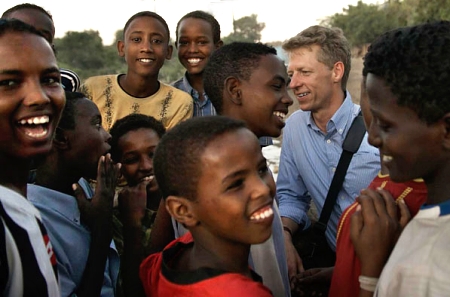
There is good news in Baidoa,
however. Orbinski visits an orphanage where 300 students are housed and
schooled. The orphanage director proudly exclaims, “They are our seeds
for tomorrow’s Somalia. They are not going to walk away, they are not
going to turn their backs on their own people.”
Speaking of the 800,000 people
killed in a hundred days, Orbinski says of his work with Médecins Sans
Frontières in Rwanda, “This wasn’t a medical safari ... it was a fucking
genocide.” Wild dogs would come to the periphery of the Red Cross
Hospital in Kigali at night to eat on the corpses. In addition to the
usual battlefield injuries encountered in a field hospital, they had to
deal with the large number of gruesome wounds caused by machetes, the
weapon of choice of the Hutu genocidaires.
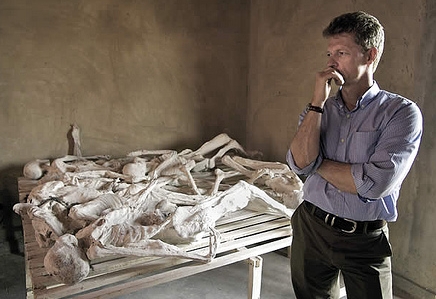
One Rwandan survivor takes
Orbinski to a hut where exhumed bodies, preserved in lye, await the
visitor. He explains he has been digging up the bodies and treating them
with lye in order that the whole world will know what happened in those
hundred days.
Director
Patrick Reed ("Shake
Hands with the Devil: The Journey of Roméo Dallaire," and "Tsepong:
A Clinic Called Hope") and producer
Peter Raymont worked with
White Pine Pictures and the
National
Film Board of Canada to bring Orbinski’s experiences in Rwanda and
Somalia to the screen, receiving the 2008 Deborah Fletcher Award of
Excellence in Filmmaking on International Development.
Orbinski speaks of a personal
transformation, “My transformation is not purely based on my work.”
It is a change his parents noticed when he returned home to Canada for a
visit shortly after his field experiences. His father told him, “You
can’t just lie down in the snow. You’ve got to get up.” Eventually,
Orbinski found an outlet for his grief – writing the book "An
Imperfect Offering: Humanitarian Action in the Twenty-first century"
(2008).
Médecins Sans Frontières was
awarded the Nobel Peace Prize in 1999, and as its president, Orbinski
accepted the prize in the award ceremony in Oslo, Norway.
“Feelings are absolutely vital to
us as human beings," Orbinski says, "but it does not stop there.” He
calls for humanitarianism beyond compassion – as a citizen, each one of
us has a responsibility to address the causes that made for the
humanitarian crisis under consideration.
He has made a measure of peace
with himself, saying, “I’ve struggled to live my life the right way as I
saw it, that respects the dignity of others, even that of our enemies.
This is the lens by which we should see the world.”
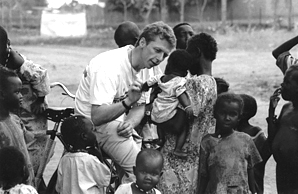
"Triage" is a difficult film to
watch. What it documents is hard to believe. But you must believe.
Dr. James Jude Orbinski is
currently Associate Professor of Medicine at the University of Toronto,
and a Fellow at the Munk Centre for International Studies. He is a
co-founder and Chair of the Board of Directors of Dignitas
International, an organization devoted to providing access to treatment
for HIV/AIDS.
Music in "Triage" includes songs
by K’naan, a Somali-Canadian poet and musician, and by
The Mighty Popo,
a Rwandan/Burundian refugee currently living in Canada.

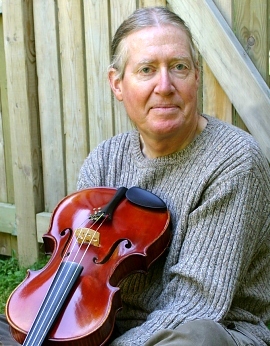
©Photo
by Lois Siegel
The Mighty Popo
Postscript: A higher
military court in the Rwandan capital Kigali has upheld the life
sentence of Major General Laurent Munyakazi for crimes against humanity
and conspiracy to commit mass murders during the 100-day 1994 Rwandan
genocide.
On December 18, 2008, a United
Nations court sentenced Theoneste Bagosora to life in prison for
masterminding the slaughter of 800,000 people in Rwanda in 1994.
“Colonel Bagosora is guilty of genocide and crimes against humanity and
war crimes,” the court said.
Trailer