|
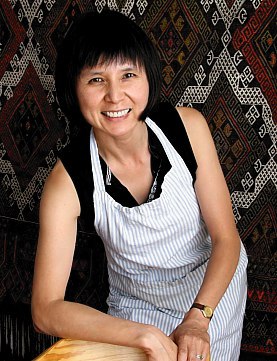
Wenxi Chen
During the week, Wenxi Chen is a software
manager
at Nortel Networks in Ottawa, Canada. To relax, she bakes and cooks –
this is her favorite occupation in contrast to her daytime work.
Wenxi loves to
try new recipes, varying them to fit her family and friends’ tastes.
Asian food
is her specialty, but when she makes desserts,
she leans towards European
influences.
Every morning she dips one finger into a dish of fish sauce and tucks her other
fingers
into the whipping cream. |
|
Green
Onion Oil Cakes
Anyone who has been to China or to authentic Chinese restaurants will probably
have tasted Green Onion Oil cakes. They make a popular family style side dish
and are also often eaten at breakfast or as a snack. As a side dish, they go
well with most Asian soups. There are many different recipes and various ways of
making them; some use yeast, and some others use pork fat instead of oil. I
remember buying Onion Oil Cakes from street vendors in Shanghai who prepared
them in a Tandoor- like oven, heated by coal. I would watch the process for
hours.
Though I have made the cakes many times, they turn out slightly differently
every time, but always delicious. This is the beauty in preparing food.
Dough
- 1 (1 1/3) cup milk
- 1 tsp salt
- 3 (4) tbsp cooking oil
- 3 (4) cups flour
- 1 1/2 (2) tbsp sugar
- 1 to 2 tsp yeast
The amounts yield about 22-24
cakes. The amounts given in the parenthesis yield about 30 cakes.
Put the ingredients in the bread machine in the order specified. Choose the
dough cycle.

Filling
- 1 bunch of green onions, finely sliced
- salt
- olive oil
- flour for dusting

Preparation
- When the dough is ready, roll it out
into a long log. Cover it with a moist cloth to prevent it from drying out.
Cut a portion (about 70g) from the log.
- Roll it into a long strip. If needed,
use some flour for dusting. Brush the upper side of the strip with oil and
sprinkle with salt evenly across the length. Put the onion along the middle
of the strip.

-
Fold the strip lengthwise
to wrap the oiled side with the onion inwards.

Then cut the long piece in half. Fold one of two pieces in three layers.
-
Press and roll it into a disc about 7-8cm in diameter. Dust with flour if
needed. Then repeat the process with the second piece. (Note: The 70g
portion yields two cakes.) Stack the cakes using parchment paper to separate
them.

Now repeat the process with the remaining dough log until it is
finished.
Cooking
- Using medium heat, warm the olive oil
in a flat frying pan. Cook the cakes, and brush the top with olive oil
before flipping it over.
Storage
Lemon
Grass Shrimp Soup (Tom Yum Goong)
From the book "Simply Thai
Cooking" by Wandee Young and Byron Ayanoglu
Ingredients
- 4 cups water
- 1/2 stick lemon grass
- 4 lime leaves
- 1 inch galangal root
- 1 fresh hot chili
- 3 tbsp fish sauce
- 1 tsp sugar
- 1 1/2 tsp chili paste
- 8-10 button mushrooms, halved or
quartered
- 16 large shrimps, shelled and
deveined
- 3 tbsp lime juice
- Fresh coriander leaves for
decoration
Preparation
- Smash the lemon grass with a flat
knife and cut into large pieces; tear the lime leaves into halves or
thirds; cut the galangal into chunks; and cut the chilies
(If a less spicy soup is desired, leave the chilies whole. The seeds are
especially hot)
- Heat water to boiling
- Add the lemon grass, galangal, lime
leaves and chilies to the boiling water for 1-2 minutes, and then remove
them.
Add mushrooms, fish sauce, sugar and chili paste, and boil for 2
minutes. Add shrimps and lime juice and lower heat to medium-high. Cook
for 1 1/2 - 2 minutes, just until the shrimps have turned springy.
Spoon into soup bowls, decorate with fresh coriander leaves and serve
immediately.
Chicken Satay
From the book 'Simply Thai Cooking' by Wandee Young
- Rice dish modified with added
green peas to give more color
- Rice and Satay plate decoration
inspired by a photo from 'Cooking from A to Z'
Ingredients
- 1 lb skinless, boneless chicken
breast
- Marinade
- 1 tsp black pepper
- 1 tsp ground cumin
- 1 tsp ground coriander
- 1 tsp turmeric
(Note 2)
- 1 tsp chopped garlic
- 1 tbsp sugar
- 1 tbsp oil
- 1 tbsp Soya sauce
- 1 tbsp lemon juice
- 1 tbsp fish sauce
(Note 2)
- 12-16 bamboo skewers
- For decoration: Lettuce leaves,
fresh coriander leaves
- Dipping sauce: Peanut Sauce
Preparation
- Slice the chicken breast into thin
narrow strips
- Marinate the chicken by adding the
solids first and then the liquids. Mix gently. Store in the refrigerator
for 2 to 24 hours. Shake the container once or twice to mix the marinade
and the chicken well
- Thread chicken pieces onto skewers
- BBQ the chicken as desired. The
satays are done when they have turned golden brown and crispy along the
edges.
- Serve and decorate with fresh
coriander leaves.
Note 2: The original recipe calls for
less turmeric and fish sauce. I use more turmeric for color and more fish
sauce for flavor.
Peanut Sauce - recipe from 'Simply Thai
Cooking'
Ingredients
- 150 g roasted unsalted peanuts
- 4 cups unsweetened coconut milk
- 2 tbsp red curry paste
- 2 tbsp sugar
- 3 tbsp lemon juice
- 2 tbsp fish sauce
Preparation
- Process and grind the peanuts in a
blender until they are fine meal.
- Heat half of the coconut milk in a
saucepan at high heat and add the red curry paste. Stir occasionally for
10 minutes.
- Add the peanuts and the rest of the
coconut milk. Lower the heat to medium high.
- Add the sugar, lemon juice and fish
sauce. Cook for 15-20 minutes, stir occasionally, until the sauce has
thickened a bit.
I crush the peanuts in a plastic bag
with a rolling pin first before grinding them in the blender. The time I did
not do that, I almost got peanut butter instead of ground peanuts.
Sauce can be stored in the fridge for
days or in the freezer for months. When needed, reheat the sauce in a
microwave for 5-10 seconds at a time - stir often, until the desired
temperature has been reached. Sauce should always be served warm.
Onion Sesame Sticky
Rice
Inspired by a recipe from 'Cooking from A to Z' by Patricia Yeo
Ingredients
- 2 cups of sushi rice or round grain
rice
- 1 cup of finely chopped onion
- 2 tbsp oil
- 1 tbsp sesame oil
- Peppered salt (sea salt, pepper and
chili powder) to taste
- 1/2 cup green peas (for color)
Preparation
- Prepare rice in a rice cooker. When
ready, pour rice into a bowl and fluff it a bit
- Heat oil and cook onion for 3-4
minutes. Lower the heat and cook until the onion has released its flavor
entirely and turned dark brown. This can take 20 minutes.
- When the rice is ready, pour rice
into a bowl and fluff it a bit before stirring rice and the green peas
into the onion mix. Stir and season the rice.
The rice can be served in a bowl or
formed into a desired shapes by using e.g. a bowl or a small quiche pan. Use
PAM to grease the form, press the rice mixture firmly into the form. Flip
the rice mixture upside down to a decorated plate.
The rice and Satay dish decoration was
inspired by a photo from 'Cooking from A to Z' by Patricia Yeo.
The idea of forming the rice into a mould can be applied to
dishes of other nationalities. One could make a giant sushi using this
method; topped with raw fish, or steak with Japanese flavors and/or other
ingredients used for making sushi.
Decorations

Mango Pudding
Malay dish
Ingredients
- 1 small can of peach slices
- 1 small can of mandarin oranges
- 3 oz peach Jell-O
- 500ml whipping cream - not whipped
- 1 can (850g) of mango pulp
- For decoration: A few mandarin orange
pieces and fresh mint leaves.
Preparation
- Cut the peaches and mandarin oranges
- Boil 1 cup or less water; dissolve the
Jell-O thoroughly in it; and cool for 1 minute
- Mix the fruit pieces, the cream, the
mango pulp and the Jell-O well
- Refrigerate for at least 4 hours
- Decorate and serve.
Note: I take only half of the mango
pulp. A whole can makes the pudding too sweet. One can also try to vary the
Jell-O and cream amounts liberally. If one wants the pudding to be firmer, use
more
Jell-O powder and less water. If one wants the pudding to be creamier, add
more cream. Mango pulp is available in Indian grocery stores.
|